
IMHOF

IMHOF
STARTING AT THE VERY BEGINNING
It all started in 1888 with Frédéric Imhof, son of a farmer, who entered the watchmaking world via the art of dial making, and in particular enameling and miniature painting. Once Frédéric had fully mastered his craft, he moved to Bassecourt, near Delémont, where he set up his very own Manufacture.
From 1900, other members of the Imhof family joined him, including his son Arthur who started as an apprentice enameler and stayed with his father until he received his diploma. After a brief economic crisis and several years in active service during World War 1, Arthur decided to move to La Chaux-de-Fonds, where he put his dial-making skills to use in the clockmaking industry, learning more about the artistic side of clockmaking, but also the technical side of the business.
On 29 February 1924 – at the relatively young age of 32 – it was Arthur’s turn to spread his wings, setting up his own workshop in La Chaux-de-Fonds .
He named his new entity the Manufacture de Pendulettes d’Art Arthur Imhof S.A. and started to focus on high-end timekeeping, employing numerous artisans specialized in different decorative crafts to create true horological works of art. Entrepreneurship was obviously something that ran in the Imhof blood!
MANUFACTURE
DE PENDULETTES d’Art ARTHUR IMHOF
By the 1930s, the business was also creating its own mechanical clock movements, and not any old movements either, these were eight-day mechanisms that were gilt and finely engraved. These calibers only had to be wound once a week, which was particularly rare at the time. The clockmaking technology was just as important to Arthur as the aesthetics of the clocks themselves.
Not content with these accomplishments, the company created numerous complicated movements and even experimented with radio receiver clocks that captured time using signals from the chronometric observatories. Confident in the capabilities of its movements, the firm offered a two-year guarantee on all its clocks, another rarity in the industry at the time.
A FLAIR FOR DESIGN
Starting as dial makers, the Imhofs were master craftsmen at the core and this shone through in their work. They created magnificent handmade cases out of precious metals, brass, and crystal, as well as their own dials, which were works of art in their own right. Enamel work was omnipresent throughout their time-keepers over the years and keen collectors can still find some truly incredible pieces at auction today.
HISTORICAL INSPIRATION
One of the advantages of the Manufacture de Pendulettes d’Art Arthur Imhof was the huge catalog of designs on offer. Arthur found inspiration in different periods of history with clocks inspired by the Renaissance period, as well as the Baroque, Louis XV and Empire epochs. The names of the collections were equally inspiring, with Les Dimensionnelles, Les Astrales, Les Nau- tiques, Les Précieuses, and Les Emaux, to name a few.
FROM A WORKSHOP
TO A FULLY-FLEDGED MANUFACTURE
From the 1930s to the 1960s, the company went from employing a handful of workers to a couple of hundred people. Arthur had built the firm and its reputation to the highest level. After a while, he wanted to offer his clocks to a wider audience and started creating new, more affordable lines that maintained the high quality, while introducing Imhof clocks to a new audience across the world. The Manufacture quickly became truly global, shipping clocks to the Americas, Asia and beyond. The company also provided a private label service that involved making clocks for some of the big names in the watch industry, such as Cartier, Bulgari and Bucherer, thanks to its reputation for excellence and trustworthiness.
A FAMILY AFFAIR
In 1944, Arthur’s son Pierre joined the company, taking care of the technical management side of the business. Pierre was an advocate for the watch industry and would go on to be one of the founding fathers of the International Watchmaking Museum in La Chaux-de-Fonds (MIH). His life’s mission was to help preserve the history of the Swiss watch industry for future generations to enjoy.
While the Imhof manufacturing facility became dormant at the end of the 1990s, interest in Imhof clocks never waned. Although restorations and repairs continued over the following years, no new timekeepers were produced.
REVIVAL OF A SLEEPING BEAUTY
This could have been the end of the story, with the Imhof name resurfacing from time to time in an auction catalog or two, but renewed interest in the Manufacture and its timepieceshas resulted in a resumption of production.
As a tribute to this remarkable heritage, a timepiece has been created to celebrate 135 years of Imhof history, distinguished by a special engraving on the caseback — a discreet yet powerful reminder of its legacy.
Watches
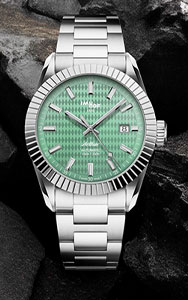
IMHOF Arthur Collection Cambridge Blue
IMHOF Arthur Collection Cambridge Blue [A18.CB0.IM.1.] embodies the timeless sophistication of Swiss haute horlogerie. Dressed in a deep, refined Cambridge Blue dial with the distinctive Imhof lozenge motif, paired with a meticulously finished knurled bezel and polished stainless steel bracelet. Powered by Sellita SW200-1 Elaboré movement, 100m water resistance, and an innovative micro‑adjustment clasp ensure uncompromising precision and versatility. Honoring three generations of Imhof watchmaking heritage, this timepiece merges historical design codes, technical excellence, and understated luxury for the modern connoisseur.
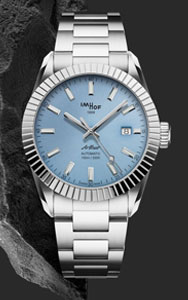
IMHOF Arthur Collection Stream Blue
IMHOF Arthur Collection Stream Blue A18.ST0.SU.1 is a Swiss‑made luxury automatic timepiece rooted in the 1888 horological legacy of La Chaux‑de‑Fonds. Featuring an elegant Stream Blue dial with the signature Imhof family crest diamond pattern, sunburst knurled bezel inspired by the brand’s iconic turtle clock, and a 316L stainless steel case with 100m water resistance. Powered by Sellita SW200-1 Elaboré movement, fitted with a patent‑pending fine‑adjustment clasp for tool‑less sizing. A modern tribute to Arthur Imhof’s pioneering spirit, blending ancestral craftsmanship, avant‑garde design, and exceptional wrist comfort for discerning collectors.